Start Your Own Boxing Tape Brand: The Market, the Factory, and How to Begin
What the category data actually shows, why China manufactures it, and how a brand gets from an idea to its first shipping carton
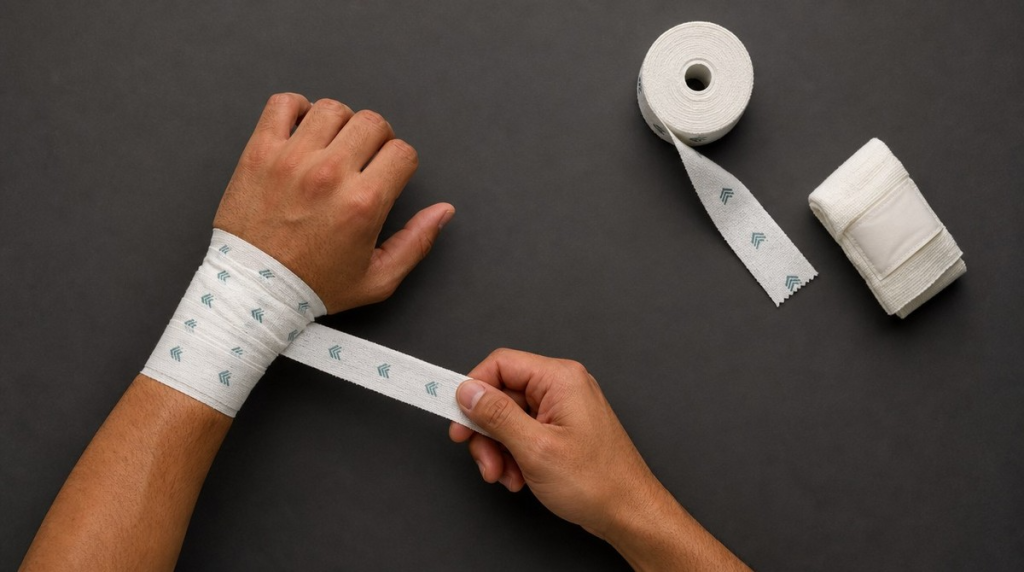
Most people who want to start a sports tape brand begin in the wrong place. They spend their first month designing a logo. The brands that actually launch spend it answering three questions: is anyone buying, who will make it, and what will make a buyer pick my roll over the one next to it on the shelf.
This article answers those three questions with numbers, and then shows you where we fit — because we build boxing tape for brands, and the fastest way to decide whether that is useful to you is to look at the same data we do.
Is this actually a good business?
Short answer: the category is growing, it is not seasonal, and the demand is concentrated in a price band where a small brand can compete. Here is the evidence.
Third-party research houses size the category differently, so read these as a range rather than a single number — what they agree on is direction, not magnitude.
| Indicator | Forecast | Source |
| Boxing equipment market | $2.0 bn (2024) to $3.3 bn (2032) | Verified Market Research |
| Boxing equipment market | $5.25 bn (2026) to $7.97 bn (2034) | Fortune Business Insights |
| Boxing equipment market | $4.781 bn (2025) to $7.003 bn (2035) | Market Research Future |
| Athletic tape market | $722.33 m (2026) to $1,555.83 m (2035), 8.9% CAGR | Business Research Insights |
| Athletic tape market | $818.25 m (2026) to $1,642.42 m (2034) | Straits Research |
Boxing tape sits inside both of those categories: it is boxing equipment that is also athletic tape. Whichever model you prefer, the compound growth rates quoted sit between roughly 8% and 9% a year through the next decade.
Market size alone tells you the water is warm. It does not tell you whether customers are active. For that we went to the listings themselves — our own analysis of Amazon US boxing tape data, run in September 2026:
| Demand indicator | Value |
| Exact monthly searches, “boxing tape” | 7,419 |
| Broad-match monthly searches | 10,906 |
| Price band containing 95.1% of sample daily sales | $6.99 – $9.99 |
| Seasonality (coefficient of variation) | 0.284 — non-seasonal |
| Year-on-year change | +74.1% |
| Advertising cost, head term vs. attribute terms | $2.37 vs. $0.53 – $0.88 |
Read that table the way a brand owner should, not the way a category analyst would.
The demand is real and it is steady. A seasonality score of 0.284 means boxing tape does not depend on a season or an event. It sells in January and in July, because gyms and fight programmes go through tape continuously. Growth of +74.1% year on year on a non-seasonal base is the profile of a category that is being discovered, not one that is peaking.
The money is in a specific band. Almost every unit in our sample sold between $6.99 and $9.99. Above $15, the same product stopped selling — listings at $15.95 and $35 moved single units a day. This matters enormously to a new brand: the ceiling for a premium roll is not $35. It is about $10, so your packaging and positioning have to earn their place inside a narrow band rather than assuming customers will pay whatever the brand aspires to.
Volume exists at consumer prices. The leading listing in our sample moved 1,826 units a day at $8.49. A second anchor listing moved 246 units a day at $6.99. At typical single-roll gross margins in this category — roughly 36% to 38% by the agency estimates we have seen, which you should verify against your own landed cost — a brand does not need a large share of the category to build a real business. It needs a repeat-purchase product and a channel.
Advertising has a cheap door. The obvious head term costs about $2.37 a click. Attribute terms such as “rigid sports tape” run at $0.53 to $0.88 — around a quarter of the cost, with sharper buying intent. A new brand that tries to outbid established players on the head term burns its budget; one that builds around attribute and specification terms gets traffic it can afford while it learns.
The conclusion we would draw as a manufacturer is this: the bottleneck in this category is not demand. It is supply-side credibility. Somebody has to make the tape, print the brand on it, pack it for a retail or e-commerce channel, and provide documentation the brand can hand to its own customers. That is the part we do.
Why China manufactures this product
Boxing tape is a laminated textile product: cotton cloth, an adhesive system, a coating, a paper core and packaging. Manufacturing it well is a supply-chain problem before it is a chemistry problem, and that is where China’s advantage is structural rather than incidental.
Depth of the adhesive tape industry. China dominates the Asia-Pacific adhesive tapes sector, and the domestic market for pressure-sensitive adhesive tapes alone was valued at $25.25 bn in 2025, projected to reach $33.55 bn (MarketsandMarkets). Industry reporting from the sector’s own associations puts patent filings in the Chinese adhesive and tape industry at nearly 2,400 in 2023 alone. Scale like that means raw materials, release liners, cores and machinery are all sourced within the same industrial ecosystem.
The Yangtze River Delta supply chain. Textile and clothing manufacturing is one of the traditional pillar industries of the Yangtze River Delta, and the region has spent two decades building the integration that follows: fabric mills, coating specialists, packaging printers and freight consolidators within a few hours of each other. For a tape manufacturer this matters at the margins — a change of cloth weight or edge style is a conversation with a supplier down the road, not a six-week import cycle.
Export infrastructure. The Port of Shanghai is the world’s busiest container port, and it sits at the mouth of the Yangtze. For volume tape shipments, that means the manufacturing base and the departure gateway are effectively the same location — which is why a Chinese tape factory can quote a delivery window measured in weeks rather than months.
Cost and quality together, not instead of each other. The reason so much of the world’s tape is made here is not only labour cost. It is that the industry has the tooling, the process control and the quality-management culture — including medical-device-standard systems — to hold tolerances that a new-entrant factory elsewhere cannot.
Inside our factory
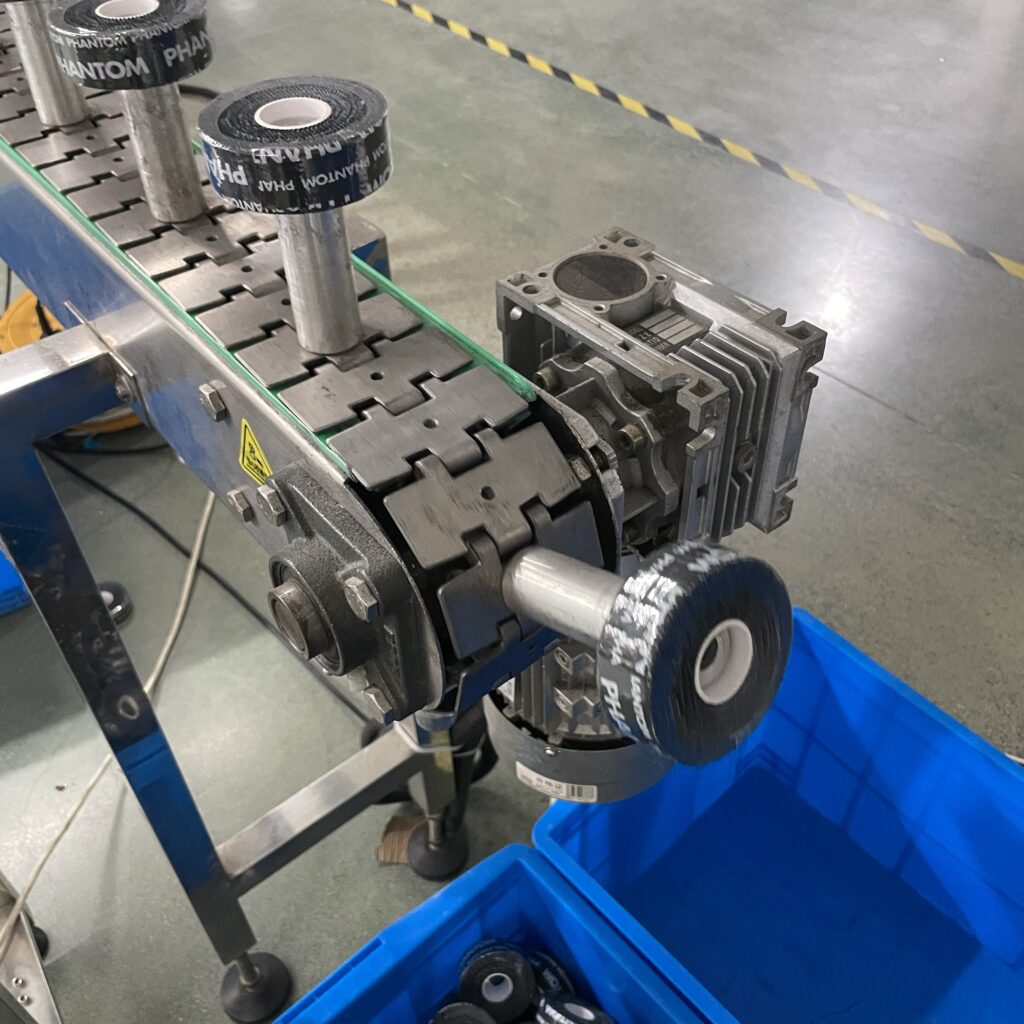
We are a manufacturer, not a trading desk. Our factory and R&D base sit in Pinghu, Jiaxing, in Zhejiang Province — inside the Yangtze River Delta. Sales and operations run from Shanghai, and we maintain a sales office in Singapore. Production runs across five lines, with coating, edge treatment and printing handled inside our own process.
Certification you or your buyer can actually check. We hold ISO 13485:2016, certified by POSI and accredited under ANAB and IAF, with the scope covering the production and sales of medical tape for export. We also hold CE and FDA registration, a product safety test report covering non-toxicity and skin compatibility, and an MSDS. ISO 13485:2016 certificates are verifiable through the CNCA register, so if your buyer’s compliance team wants to confirm ours rather than trust it, they can.
What goes into the tape.
- Zinc oxide hot melt adhesive as our standard system, coated at a weight that holds through sweat and repeated hand movement — and releases cleanly, without leaving a sticky residue on the skin.
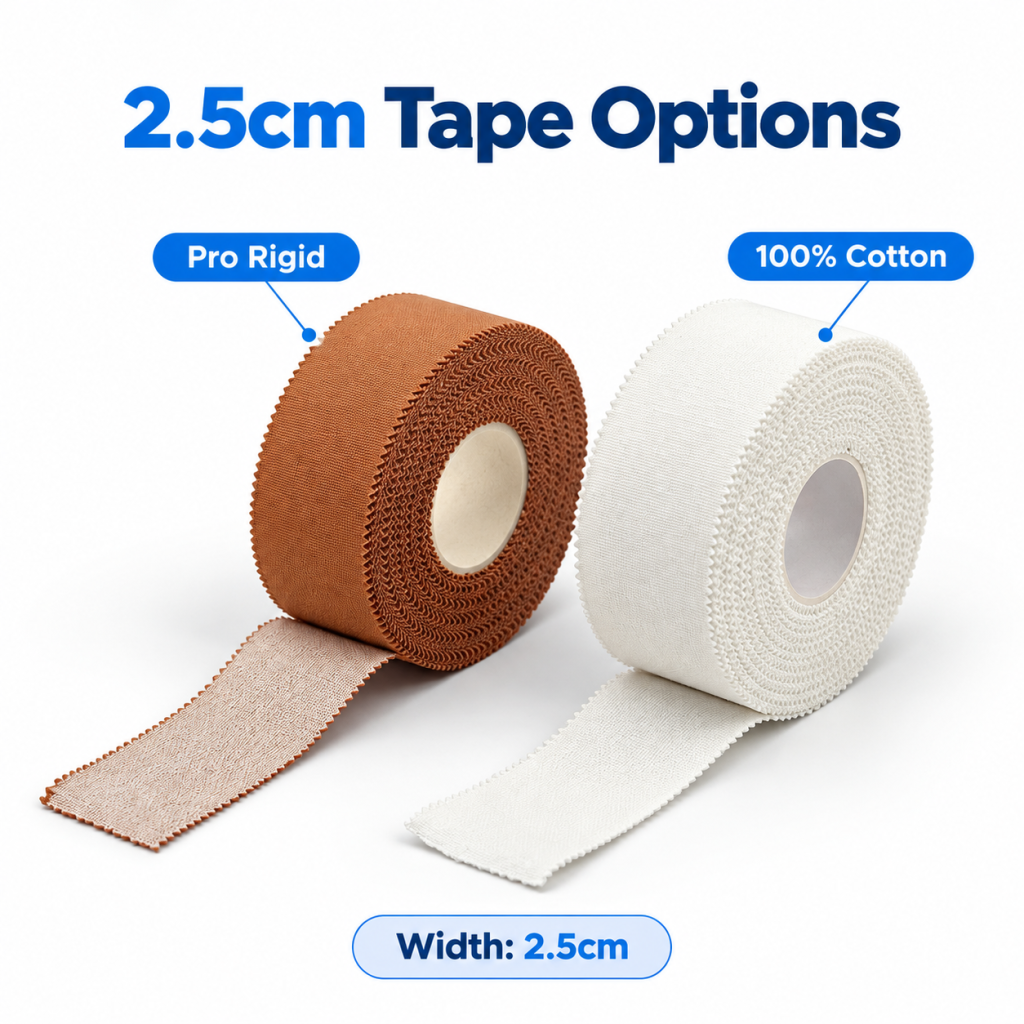
- 100% cotton at high GSM. A dense weave grips without slipping, resists tearing at the edge and keeps its weight through the whole roll instead of thinning toward the end. It is denser and more abrasion-resistant than the lighter substrates used in low-cost tape.
- Our own coating process, in two constructions: a breathable coating that keeps airflow under the wrap, and a full-coat adhesive option where maximum tack matters more than breathability.
- Serrated or straight edge, so a coach can tear it by hand or a brand can specify a cleaner line.
- Water-resistant, which is what grip under sweat actually requires.
What we do for brands
Most factories make tape. A smaller number make tape that a brand can put on a shelf. The difference is in printing, packaging and communication — and that is where we have chosen to invest.
We have built this for brands across markets. Our production serves brand owners, distributors and combat sports programmes in multiple export markets, which means the questions your market will ask have been asked before: what does the retail pack look like, which documents does the buyer need, what happens if a printed colour is half a shade out. You are not the first brand we have taken from artwork to a shipping carton, and that experience shows up in how quickly a programme moves.
Printing, at every level of the product.
- Tape cloth printing — your logo or a full-surface pattern, in single-colour, two-colour or multi-colour. The colour count in your artwork is the main driver of printing cost, so we price from the artwork rather than from a guess.
- Printed paper cores — the lowest-entry way to put a brand on the product. The plate is charged once and retained in our warehouse, so every reorder reuses it at no additional plate cost.
- Colour — white, black and skin tone cover most of the market, with blue, yellow, red, pink, green, purple and army green available as alternatives.
Packaging built for the channel it sells in. This is the part that most often decides whether a launch looks professional, and it is the part we are strongest on. We produce single rolls in transparent film printed with an unwind-direction arrow, multi-roll packs, mid-boxes packed at 12 or 24 rolls, printed paper cores, custom retail boxes built to hold a specific roll count with a printed insert card, printed OPP bags and hot shrink film carrying your branding, and branded export cartons. If you have seen a packaging format in this category, it is almost certainly drawn from that list — and if your channel needs something outside it, send the dimensions and artwork and we will confirm feasibility rather than guess.
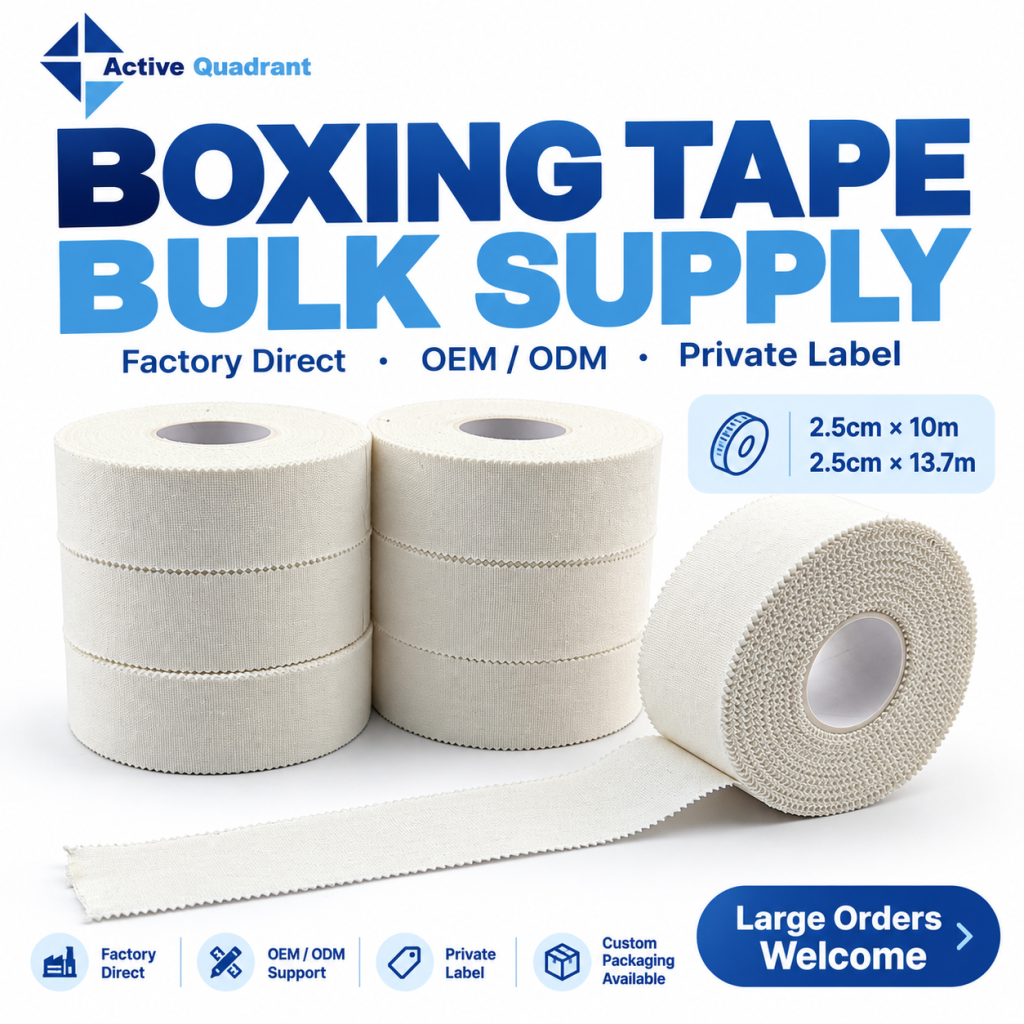
Entry points that fit a first order. Standard solid-colour tape starts at 288 rolls. A printed paper core and a coloured serrated edge both start from a small number of cartons, and a full printed run starts at 2,000 rolls for 2.5 cm × 10 m and 1,440 rolls for 2.5 cm × 13.7 m. Samples are three rolls free of charge, with freight covered by the buyer, and standard orders run 20–25 days while custom orders run 30–40 days from artwork approval.
Who this is for
We are not the right partner for everyone, and it saves both sides time to say so. If your only criterion is the lowest possible unit price, there are suppliers who will beat us, and we will not pretend otherwise — the certification, the high-GSM cotton and the printing capability cost money to hold.
We are a strong fit if you are one of these:
- A distributor or wholesaler who needs a broad size range, stable lead times, certification that satisfies your own downstream customers, and packaging that can be re-sold as-is.
- A brand owner or private label founder who wants a specific product with their name on the cloth and the core, in packaging that looks like it belongs on a shelf next to established names.
- An e-commerce seller who needs a pack that photographs well, a product page that can make a claim it can back up with documentation, and a reorder rhythm that keeps stock available.
- A gym, club or combat sports programme buying for its own members, where a single carton of solid-colour tape is a perfectly sensible starting point.
- A boxing, MMA or fitness equipment retailer adding a consumable line to a range that is currently all durable goods.
If you recognise yourself in one of those, the honest next step is not a big commitment. It is a specification and a sample.
Start your brand
Here is the sequence we recommend to a first-time brand:
- Pick one product and one channel. A 2.5 cm × 13.7 m roll sold as 1 inch × 15 yards, in one colour, into one channel, beats a ten-SKU range launched at once.
- Request samples and test on skin. Three rolls, free, freight on you. Test the tape on a hand under load before you invest in artwork.
- Decide your branding level. A printed paper core is the cheapest way to look like a brand. Cloth printing is the most visible. Coloured edges sit between the two.
- Design the pack for the shelf or the parcel. This is where most first launches are won or lost.
- Plan the window. Standard production runs 20–25 days; custom runs 30–40 days from artwork approval, so build the approval round into your launch date.
Send your specification to mani@activextape.com — target market, tape width and length, colour, branding level, packaging format and expected volume. We will come back with a quotation, a sample plan and a production timeline.
ActiveX manufactures sports tape in its own facility, supplying boxing tape, cotton athletic tape, rayon rigid strapping tape, thumb tape and finger tape to brands, distributors and combat sports programmes worldwide.
- Custom boxing tape and private label: OEM / ODM services
- Cotton athletic and boxing tape: cotton tape range
- Rayon rigid strapping tape: rayon rigid tape
- Thumb tape for hook grip and weightlifting: thumb tape range
- Finger tape for boxing and BJJ: finger tape
- Full product range: all products
- Wholesale enquiry channel: our Alibaba.com store
Email mani@activextape.com to start.